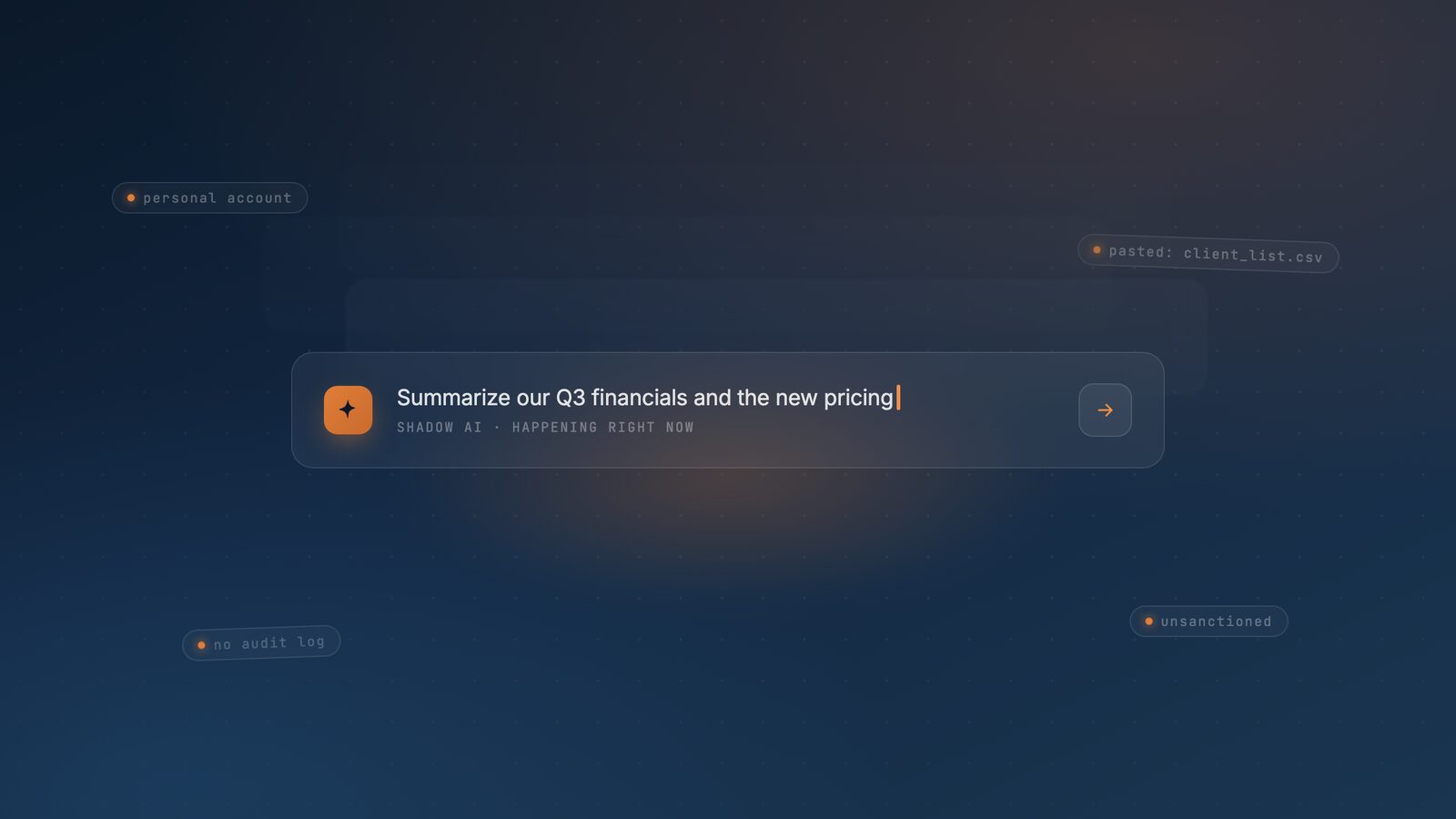
Your team has probably adopted AI on its own — pasting sensitive data into personal accounts with no policy, no oversight, and no trail. It’s called shadow AI, and the fix isn’t banning it. It’s making the safe path the easy path.
Here’s a conversation I have almost every week.
A business owner tells me, with real pride, that their team has embraced AI. “It’s been great,” they say. “People are faster, they’re getting more done, everyone’s using it.” And I’m glad to hear it — AI should be making your team faster. That’s the whole point.
So I ask a simple follow-up: “Great — what are they using, and how is it set up?”
That’s usually where it gets quiet.
The thing nobody set up on purpose
When we actually dig in, the “AI rollout” turns out to be something very different from what the owner pictured. There’s no platform. No configuration. No agreement with a vendor. What’s really happening is that an employee opened a personal ChatGPT account on their own, found it genuinely useful, and started pasting work into it.
And not trivial work. Customer lists. Financials. Contracts. Internal strategy docs. Whatever they happened to be working on that day, dropped into a free consumer tool with zero guardrails and zero oversight.
When I walk an owner through what that actually means, I watch the same reaction every time. The pride drops, and it’s replaced by a kind of stunned silence. They had no idea. Why would they? Nobody decided to do this. It just happened — quietly, one helpful shortcut at a time.
This has a name. It’s called shadow AI, and it’s everywhere right now.
Why this is a bigger deal than it sounds
Let’s be clear about what’s at stake when sensitive data goes into an unsanctioned tool:
The data leaves the building. Once company information is in someone’s personal account, you’ve lost control of it. You don’t own that account. You can’t audit it. You can’t pull the data back. And depending on the tool and its settings, that information may be retained or used in ways you never agreed to.
There’s no trail. If you ever need to answer the question “who put what where,” you can’t. There’s no log, no visibility, nothing to point to. For any business with compliance or privacy obligations — and most have more than they think — that’s a serious gap.
Your IP can walk out the door. The thing that makes your business yours — your processes, your pricing, your client relationships — can end up training a third party’s model or simply sitting on a server you don’t control.
It’s invisible. The most dangerous part isn’t any single risk above. It’s that none of it is on anyone’s radar until something goes wrong. You can’t manage what you can’t see.
The instinct to ban it — and why that backfires
A lot of owners, once the shock wears off, jump straight to “okay, we’ll just shut it down. No AI.”
I understand the reflex, but it’s the wrong move. Banning AI doesn’t stop people from using it — it just drives them further underground. Your team adopted these tools because they work, because they make the day easier. Take that away and they’ll find a workaround, and now you’ve got the same risk with even less visibility.
The answer isn’t less AI. It’s AI you can actually see and trust.
Most businesses have no policy at all
Here’s the part that surprises people most. When I ask whether they have any kind of AI policy — even a one-pager telling employees what’s okay and what isn’t — the answer is almost always no. Not a bad policy. No policy.
That’s not a knock on anyone. This shift happened fast, and governance simply hasn’t caught up. But it does mean most businesses are running on the honor system without ever having told anyone the rules. Employees aren’t being reckless on purpose; they’ve just never been told where the lines are, because the lines were never drawn.
A simple, clear AI use policy changes that overnight. It gives your team permission to keep being productive and a framework for doing it safely. This is exactly the kind of thing we help clients put in place — and it’s usually far less work than people expect.
What good actually looks like
Getting this right isn’t complicated. It comes down to four things:
-
Visibility. Find out what’s actually being used across your organization. A quick internal check almost always turns up surprises.
-
A policy. Put a plain-language AI use policy in place so everyone knows what’s allowed, what isn’t, and why. We can help you draft one that fits how your business actually works.
-
Sanctioned tools with guardrails. Give your team a secure, approved way to use AI so they get the productivity without the exposure. The goal is to make the safe path the easy path.
-
A partner who keeps it current. This space moves fast. Governance isn’t a one-time document — it’s something that needs to evolve alongside the tools and the risks.
Where Audian fits
We built audian.ai around a simple belief: AI should make your people more capable, not put your business at risk. We’re a Human-First Managed Intelligence Provider, which is a longer way of saying we help businesses adopt AI responsibly — with the visibility, governance, and guardrails that let you say yes to AI with confidence instead of fearing it.
If any of this sounds familiar — if you’ve been telling yourself your team has AI figured out and you’re now slightly less sure — let’s talk. No pressure and no scare tactics. We’ll take a look at what’s actually happening in your organization and help you get ahead of it.
Because your team is going to use AI either way. The only question is whether you can see it.
Want to talk through AI governance for your business? Reach out at 844.611.6110 or 411@audian.com — we’re happy to take a look together.